


Home from the Sea

Yep, still reading these terrible, terrible books. Still enjoying them enough to keep on, though. What is remarkable about this one is how it seizes on the trend from several of the previous, in which nothing really happens. Or, well, stuff happens, even on a regular basis, but the rise and fall of action is negligible; plot points are tossed about carelessly, and the drama! and tension! that you can see coming from the second chapter really only coalesce in the last twenty pages and are neatly resolved as always.
That being said, I did enjoy much of the non-narratively-important happening of stuff. It reminded me a bit of The Fire Rose or at least the bits I enjoyed most about that one (which, come to think of it, was really the first in this series), in that it was a very comfortable book, in and around the drama! and plot! and just reading about people having a Christmas and New Years celebration which is atmospheric but entirely irrelevant to pretty much everything else in the book is kind of soothing. Lingering, loving detail is spent on a train journey, the narrative importance of which was pretty much, "They got from A to B. It took a long time. They met a guy." Which takes, like, almost as many pages as multiple final confrontations/battles.
Oh, Mercedes Lackey. That pretty much could be the entire review, just, "Oh, Mercedes Lackey." And, well, you'd know what I mean, wouldn't you?

Sorry Please Thank You: Stories
 Lordy, I like the way this guy plays with ideas, the way he pokes at reality, the cleverness of their exploration. Lordy, I do not like the way he writes about women, on the few occasions he does. It's v. old skool SF in how ladies are only important in how they affect and relate to men. Women are not granted an interior life; I mean, even in the story that explicitly grants the male protagonist access to the previously-impenetrable thoughts of the female love object, she is only thinking about him. The entire narrative of this woman, this story, is that the male POV character had no idea what was going on inside her, and when granted that access, turns out what's inside her is pretty much him. Which is way more innuendo-y than I intended, but still.
I'm torn as to whether to read his v. popular book, as I think his ideas would be fascinating and cleverly executed, but I'm not particularly keen to read yet another interesting book in which the only interesting people are dudes.

The Demon's Surrender
 This book falls much more into the standard Young Adult Fantasy Romance tropes than the previous two books in the trilogy, which made it both more immediately engaging and less interesting. Like, the dialogue and developing romance was snappy reading, but I just. didn't. caaaaaaaaaaaare. In fact, most of the romantic relationships between the teenagers by the time we've reached this last book are kind of icky (Sin and Alan! Out of nowhere! 2getha 4eva 4 no apparent reason! What? Heeeeey, Jamie gets a love interest! ...it's the dude who used to beat him up and occasionally swapped that out for stalking him! Are you for serious?) except for Mae and Nick. The most emotionally resonant pairing is the one with the character whose emotions explicitly - and pretty damn consistently - Don't Work That Way. And, you know, the only one with three books developing that, instead of slapping it all together at the end.
 And it's a bit of a shame, because I think there's some really interesting stuff with Sin here - balancing the magic family/nonmagic family, economic and race issues actually being mentioned and incorporated into the plot in the ways they have very really effects on her life!, etc. - but I feel like when push comes to shove, they take a backseat to the And Now We Love Each Other SO Much, You Don't Even Know thing with Alan. And, frankly, they both deserve better (and need to GROW UP MORE before they're pairing off forever and ever, but that may just be my frustrations with much of the young adult genre talking there).
Also also, as much as I enjoy Mae and her prickliness, how much she finds her place in this new world with her deep seated practicality with the carnival, I cannot help but look MAJOR side-eye that has the white muggle waltzing in and kicking out the black girl who's been raised and trained for this all her life. (And, no, the "we'll reconsider this in seven years" thing doesn't make me less eye-rolly.)
Side-eye aside, I did agree when the text explicitly had them say, "Hey, at least we're not fighting over a boy?" Progress! I think?
Also hat tip to the whole series for being exactly as gruesome and full of death as it really ought to be. And for having that gruesomeness and death have explicit, on-screen consequences.

My Misspent Youth: Essays
 These essays' strengths are the author's skill in the writing craft - structure both in the macro (narrative) and micro (sentence) level. Damn can she pull an essay together. It's always nice to read someone who knows how to handle an ending.
 These essays' weaknesses are in the author's seeming inability to acknowledge her own failings without trying to justify those failings, in a backhanded, narrative-structure kind of way. I mean, good on her for actively acknowledging when she expresses ideas, often about class but occasionally ethnicity, that are rooted in prejudice and stereotype and do not reflect well on her. That are unflattering. I am all for that kind of honesty, exposing one's ugly, raw bits on the page and thinking about them out loud. What I'm not so much for is then wrapping around to wink and nudge at, "well, when you really look at it, wasn't I kind of right? wasn't I kind of justified in sneering at [the poor/the helplessly bourgeoise/people who choose to live their lives differently from me]?" And to do that again and again, in essay after essay.
The worst offender in this category for me was the essay on the polyamorous family who were also science fiction/fantasy fans of the tie-dyed wolf t-shirt/I am channeling the Norse pantheon/I have figurines of my gaming character variety. The author graciously finds it in herself not to dislike/pity them because they have unconventional sexual relationships; no, she pities them because she loathes their taste in books and they will (and I loosely quote) never know the joy of loving someone who has unfamiliar books on their bookshelves (which is a lesser sort of relationship, clearly). Now, she's not wrong about the joy that can be found in being introduced to new books/art/culture/whatever by someone you love, but it all just comes off as judging people who even she portrays as essentially pretty happy with their lifestyle and hobbies for not liking books that she likes. Oh gosh, these poor people who will never know the joys of literary fictions!
Yes, as a science fiction and fantasy fan, as a geek, I'm a little sensitive on this. Even if the people described are probably not anyone I'd be clamoring to be BFF with, I cannot despise them because of their desire to seek people out who love the same things they love, no matter how much the narrative structure of the essay encourages me to.
To be slightly more generous, I do wonder if some of these essays rub me quite as poorly as they do because of how dated they are. It is very, very clear these essays are well more than a decade old, and it's kind of fascinating by how many things that might have been outre or challenging initially are now kind of banal and HuffPo-y. Oooooh, online romance. How daring. How shocking to find out the person you created in your head based on correspondence can never be equaled by the actual human being. Oooooh, you've got massive student loans and consumer debt from a series of choices that made a sort of sense at the time but are crushing and crushingly illogical in retrospect. I get that with more honesty and more sympathy and more, I don't know, humanity from The Billfold on a daily basis. Basically, I think this book has been entirely trumped by the internet, even if the author is a damn sight more skilled than large swathes of the internet.

Committed: A Skeptic Makes Peace with Marriage

After my pretty negative reaction to the last 2/3rds of Eat, Pray, Love, I'm as surprised as you are that I even picked this book up. But 1) I'm actually very interested in reading about women who are skeptical of the institution of marriage/actively do not want to be married and 2) I thoroughly enjoyed Gilbert's 2009 TED talk on creativity, which found the balance between the slightly foofoo mysticism and practicality that was missing for me from most of Eat, Pray, Love, as well showing a practicality of "this happened; what next?" that I found v. appealing. She made me want to hear more of her thoughts, even if I didn't fully agree with them, which I found rather remarkable.
And you know what? I thoroughly enjoyed this book. It was far more Italy than India or Bali; it was on a topic in which I was already interested (so, you know, spaghetti instead of spirituality); it was engagingly written, and it avoided all the bits of her other nonfiction that made me cringe. It's funny; I deeply resented reading about her deeply personal spiritual experiences, but I thoroughly enjoyed reading her very personal musings on marriage.
Yes, she draws on some more universal research/case studies/etc., but let's be real - this is no Straight (which, for the record, I adored). This is someone coming from a very mainstream perspective - white, straight, cis, upper/middle class, American - and she makes no bones about that. She does a fairly good job of acknowledging that, of at least brushing on the way not fitting into these categories can affect other people's thoughts and feelings on marriage, but that is not at all her focus. I see it as both a strength (precision of focus) and weakness (narrowness of focus) of the book. Hell, I'm just glad the fact that it is an acknowledged focus, rather than assuming this is Just The Way Things Are.
Gilbert skirts a bit close to The Magical Rural People Of Color Are Teaching The Nice White Lady! thing in her explorations of marriage in the small southeast Asian communities in which she (I was originally going to say "found herself," but, no, it was very much an active choice for her) was traveling while writing this book. Still, I give her credit for at least a) being better than she was in the India/Bali sections of Eat, Pray, Love and 2) calling herself out on Nice White Ladyness on more than one occasion.
I think what I found engaging about this book is exactly what I found offputting about Eat, Pray, Love: it is a very personal thought process seen through the lens of something larger/historical.* It just so happens that this time around I'm far more engaged by her personal decision-making process and am more interested in the topic of how and why people choose to perform pair bonds than a search for inner peace.
*Fair caveat - I may be ranking this book higher than it necessarily should be just because I am so. very. glad. that she was a) aware and b) very clear that it was a personal story with research-y context, rather than pretending/tricking herself into thinking it was a research-y examination with personal context. I've been suckered into one of those sorts of books one too many times, and Gilbert's relative transparency about what she was trying to do with this book was delightfully refreshing.

The Night Circus
 I am enraptured by this book. It will either work for you or not, and it worked in spades for me. This book is not really about plot and only loosely about the main characters; it is all about atmosphere and world-building, both in place and in the background pastiche of characters. It's the sort of book whose enjoyment benefits more from a sense of whimsy and wonder than skepticism, one that focuses more on the results of the magic than describing the structure behind it, and I am a-okay with that. It's a magic competition housed in an unusual circus at the end of the 19th century - you're either already clamoring for more, or your not.
To be very honest, I didn't particularly care about the main characters, their teachers, or their love story. I was not invested in how things turned out for them, even if I did love the distinctly non-confrontational aspect of the ultimately-still-ruthless competition. I was in this entirely for reading about the circus - both the descriptions of the acts/tents/performers themselves and the, for lack of a better word, fannish community that sprang up around it. Morgenstern gets that sort of consuming enthusiasm for someone else's creative work and captures it beautifully. That right there would be enough to win me over, even if I didn't want to be consumed by enthusiasm for the circus, too.
Full disclosure: at least in large part I think my huge enjoyment of this book is because I spent the vast majority of it going, "Eeeeeeeee, this reminds me so much of Sleep No More, except with magic!" (in feeling, if not actual substance), which remains one of my favorite theater experiences ever. And, quelle surprise, in the author's note at the end, she acknowledges Punchdrunk, the company behind Sleep No More, as an inspiration. So, you know, it's a good recommendation vehicle. Did you like Sleep No More? You'll love The Night Circus! Did you love The Night Circus? Get a small taste of it in person with Sleep No More! And much like Sleep No More, the more you are willing to run with the set-up, the little hints and tastes of the world the author gives you, the more you'll get out of it.

A Gentleman Undone
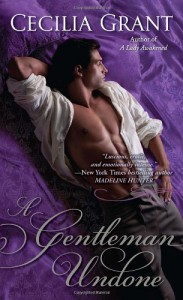
Cecilia Grant is a delight. Her books have all the delicious trappings of romance novels, but there is something decidedly unromantic about them, which only makes me love them more. She manages to hit most of the beats you expect from a fairly classic romance novel plot - hero needs money to help him escape his ghosts form the war; heroine is a Fallen Lady who needs money to set herself up apart from her lover; together they fight crime! gamble! - but she subverts the emotional impact or twists the consequences of those beats almost every single time.
You actually believe the heroine is a math whiz, because it's shown onscreen. Speaking of - not only does the Fallen Lady heroine have sex with her client, she does so onscreen and to her own enjoyment. I also appreciate that this is the second novel in which Grant includes a scene (or in the case of A Lady Awakened many scenes) where the hero and heroine have deeply, deeply unsexy sex that moves the plot/their character arcs along. That sex is not a one size fits all thing.
I also very much enjoy how she does the romance novel thing of making everything work out in the end and gets to that same happy ending you'd expect in a more traditional romance, but there are always consequences and often sacrifices--meaningful ones--to the choices the hero and heroine make in order to be together. All in all, a delight. Still a confection, but a salted caramel instead of saltwater taffy. I enjoy them both but for very different reasons.

A Lady by Midnight
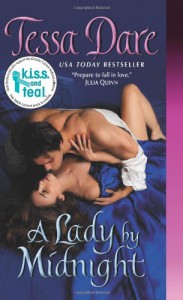 I thoroughly enjoyed the heroine and at least thoroughly believed how much she loved the hero, even if I stayed upset longer at some of his shenanigans than she did. I just have no truck with the whole "I did/didn't do a thing for your own good, which I know better than you!" thing. I'm also not super-keen on the "she's so magnificent and above me, I'm not wooooorthy" moaning by heroes in general, but this guy was far better than usual. Also, total bonus points for an ending that didn't involve everything being fixed by a fabulous inheritance and gentrifying (er, literally). At least until the epilogue.
Mostly, though, I am deeply cranky at the "wacky" climax (not like that) of the plot where the hero and the sequel-bait second cousin swordfight and joust for the heroine's favor, even though she has explicitly asked them not to and attempted to intercede. It all smacked very much of "let the men sort things out between themselves, honey, and you'll take whatever the outcome is and like it," which seemed woefully out of tune with the rest of the novel. Sure, Dare saves it at the end with the heroine coming up with her own pair of scissors to cut through the tangle of inheritances and affections, but I had to skim the fighting scenes, I was so put off by it.
Also, if the sequel-bait second cousin does get his own novel, he's gonna have to deal with those possessive, anger management issues real quick, or I will have none of it. None. Eurgh. Seemed like a decent enough fellow on some occasions, but the "quirk" of his anger was deeply offputting.
However, I love love loved the female cousins who showed up, especially Harry the lesbian in a snit with her lover. I would read a book just about them and their tempestuous but eternal and sheetscorching love in a heartbeat.

A Week to Be Wicked

I'm very glad I didn't let my distaste for the first book in this series (A Night To Surrender) keep me from trying this one, because it was delightful. A lovely wallflower/rake pairing, with suitably tragic backstory and bonus dinosaurs! Nobody was overly possessive or overly dumb (though we edged a bit close to the "I know what's best for you" line a time or two, and the levelheaded scientist "just knows the lizard is a girl" what whaaaat?); there were Wacky Hijinx on the Road. It's the sort of novel I would recommend to people who are already inclined to like romance novels, not an introduction to romances, but it is a sweet little read nonetheless.

Don't Tell Alfred
 This is Nancy Mitford cranked up to eleven. It's a little grating when everything is that much more ridiculous, that much more staged, and every character's eccentricity is cranked to eleven. However, it works in everyone's favor when Mitford is exquisitely on point with some of her ruminations about France, about parenthood, about changing times, about Paris itself. There are these tiny moments of loveliness slid in amongst the ridiculousness that will have you idly researching plane tickets to France before you quite know what's happened.
 And, okay, real talk - I find Northey ever so much more intolerable than Linda, her mother-in-spirit, because unlike Linda, Northey ostensibly has a job. And she is awful at it. I can, in fact, find delight in reading about someone who exists solely in a realm of frivolity and social acquaintance and social machinations, but apparently my too, too bourgeois soul rebels when that person is also supposed to be doing a job and instead foists off all responsibility on anyone who finds her charming enough. This is Northey's book as much as it is Fanny's, and it turns out that I prefer things when Fanny is a bit apart from the action and the subject of her musings doesn't even make a pretense to working for anything other than her own amusement.

Necromancing the Stone
 Snappy dialogue, people growing up hard but honestly, and building your own family as the emotional focus, plus, you know, zombies? Hello, my fictional friends, I have miiiiiiiissed you!
 Seriously, I could read about everyone hanging out at Sam's house and their wacky day to day adventures all. day. long.

The Demon's Lexicon
 First half was tedious, albeit with necessary scenesetting and emotional buildup that gave the clearly foreshadowed twists much of their impact. Once Shit Started Going Down, though, I was totally in. I actually found the worldbuilding dull, if competent, which is usually where I'm invested. I was fully prepared to force myself to finish the book for completion's sake, but the author started hitting all sorts of emotional buttons for me--family, feelings of inadequacy, deliberate wallowing that ignores actual truth for emotional truth, etc--just as Shit Was On The Rollercoaster Incline Before Going Down, and now I'm going to the library tomorrow to get the sequel. Like you do.

Madame de Pompadour
 My interest was held much more unevenly than the four stars would otherwise indicate, but the good parts were just that good.
 Mitford makes no attempts to disguise her bias and interest, which makes for an eminently more readable biography than many. She's also far less meticulous with in-line sourcing than I've come to expect, which has the benefit of making things seem much more vivid and immediate while making it a bit harder to tease out where things came from and how much is Mitford's own opinion versus the recorded opinion of one of Madame's contemporaries.
Likewise, Mitford assumes a level of historical familiarity, both with the overall shape of events and specific movements/individuals, that could easily lose or alienate a reader. I consider myself at least decently read in French history, and I spent some quality wikipedia time with this book. A footnote or twelve would've been appreciated, though Mitford's fluency with her topic is also what makes it so eminently readable.
Can one describe a biography as a romp? Because I think this was, a bit.
Full disclosure: I read this in a mix of haze of thoroughly enjoying Mitford's novels and close on the heels of adoring the Doctor Who episode of the Girl in the Fireplace. I totally tried to pinpoint the spots in the narrative where the Doctor would've shown up.

A Night to Surrender
 Dude, I'm getting ruthless in my pursuit of 110 books this year. If it's not working and I've hit 20%? I'm done. Outta there.
 Love the idea of Spindle's Cove, the haven for ladies who Just Don't Fit. Found the set-up for the Battle Of The Sexes between the Manly Men and the Ladies Who Don't Need A Man, Thank You to be skin-crawlingly unpleasant. Maybe it gets better. Dunno. Don't care. Didn't care to read more about the hero who liked smart women 'cause they're good in bed while still talking down to them.

Unveiled
 Wildly anachronistic social mores in Regency set dressing? Yes, please! Also a completely baby-free epilogue that provided a satisfying bonus resolution outside the framework of the main plot. Will wonders never cease?
I swear, romances like this read almost like fanfiction, in a way: the characters aren't shared, but the universe is, for all intents and purposes. It's so confined while still being interpreted so many different ways. I suppose that's why they're soothing. Ooooh. Now I want a Regency where the hero's been turned into a couch. Because, you know, it happens. Sometimes. I digress.
Don't read this looking for historical accuracy. Read it for a deftly handled inheritance plot in a semi-generic historic-y setting with the edges smoothed out by an author who favors putting her hero and heroine on an equal footing, where self-esteem and personal validation are concepts readily bandied about, where the hero explicitly (hur hur) makes enthusiastic consent the end-goal of his seduction. Sure, it's slightly ludicrous if you think about it too hard, but it sets up a more equal relationship between hero and heroine than most contemporaries manage.
A wild improvement over the author's Turner series for me.

The Blessing

Marvelous for Mitford's exquisite devotion to France and French society, but the characters begin to grate, ever so slightly. Whereas her frivolous society girls in The Pursuit of Love and Love in a Cold Climate come across as charming despite their ridiculousness, I spent most of this novel wanting to shake everyone, but especially Grace and Charles-Edouard. Let us not even speak of their offspring, the precocious plot moppet extraordinaire Sigi, though it is fair to say that Mitford gave him an excellent set-up and explanation for why he is as selfish and manipulative as he is. Still doesn't repress the urge to shake.
Oddly enough, I think this is the closest Mitford ever really gets to a happily ever after. That's exactly as funny and depressing as it should be.
